Simple Kadhi – Spiced Yogurt and Chickpea flour dish
[tweetmeme source=”sabera” only_single=false]
I’ve always enjoyed Kadhi ever since I was a child. Despite the perennial heat and humidity in Mumbai, I relished sipping a warm bowl of Kadhi every single time my mother made it. She’d always keep aside a bowl just for me :-).
This savory soup-y dish is enjoyed ladled over some Khichdi (A lentil and rice preparation) or some Moong Pulao (Green gram and rice pilaf). I’ve enjoyed several preparation styles of Kadhi, depending on the cultural background of the person making it. The Sindhi people, who hail from North India, make it savory and spicy, with little fried fritters made of Chickpea flour, Onions, Potatoes and ofcourse, a whole bunch of fresh spices and herbs. The crispy fritters are placed in the Kadhi and taste just wonderful when soaked in the savory, tangy liquid. The Sindhi also like their Kadhi yellow and add turmeric powder to add the color. The Gujarati people of West India, prepare Kadhi sweetened with sugar or jaggery. They make theirs on the lighter side, and without turmeric powder.

Chickpea gram flour
Something tells me that the recipe for this dish emerged from a nifty homemaker who wanted to use up some leftover and very sour yogurt in her kitchen. Very sour yogurt makes the best Kadhi. If you’re not big on the flavor, you can always use fresh yogurt that has a milder flavor. The yogurt is mixed with double the ratio of water and the mixture is thickened with chickpea gram flour, also known as Besan in Hindi. The mixed liquid is then simmered till the flour cooks, and finally flavored with powdered spices, curry leaves, fenugreek seeds, chopped garlic and fried onions. As is with all my cooking, my version is simpler, quicker, lower on oil, and in that spirit, excludes the fried chickpea fritters.

Prepared kadhi
To make Kadhi for 2, you will need:
- 1.5 cups very sour or fresh Yogurt, without any water
- 3 cups water
- 3 tbsp chickpea gram flour or Besan
- 1 green chili, sliced lengthwise
- 1/2 small tomato, seeds removed and finely chopped
- a pinch of turmeric powder
- 2 tbsp vegetable oil
- 1/4 tsp fenugreek seeds
- 1/2 tsp cumin seeds
- 1 small onion sliced
- 1 garlic clove, sliced
- 1/2 tsp chili powder
- 1 tsp Dhania-Zeera powder
- Salt to taste
Method:
- Mix the flour, yogurt and water together making sure no lumps of flour remain. If you have fresh yogurt but want to make it sour, add a few drops of lemon juice in the yogurt-water mixture and let it stand for 15 minutes or so
- On medium-low heat, simmer this liquid. Add green chilies, tomatoes and turmeric powder while it simmers
- Once the liquid is slightly thickened, around 15 minutes, in a separate pan, heat some oil
- When well heated, add the cumin seeds, curry leaves and fenugreek seeds. When they start to splutter, add the onions and sliced garlic and fry them on medium heat till they turn golden-brown
- Then add all the dry spices, mix well in the oil and pour over the simmering yogurt mixture. Mix well and add salt to taste
- Allow to simmer for about 5 more minutes. Serve hot with Khichdi or Zeera Rice.
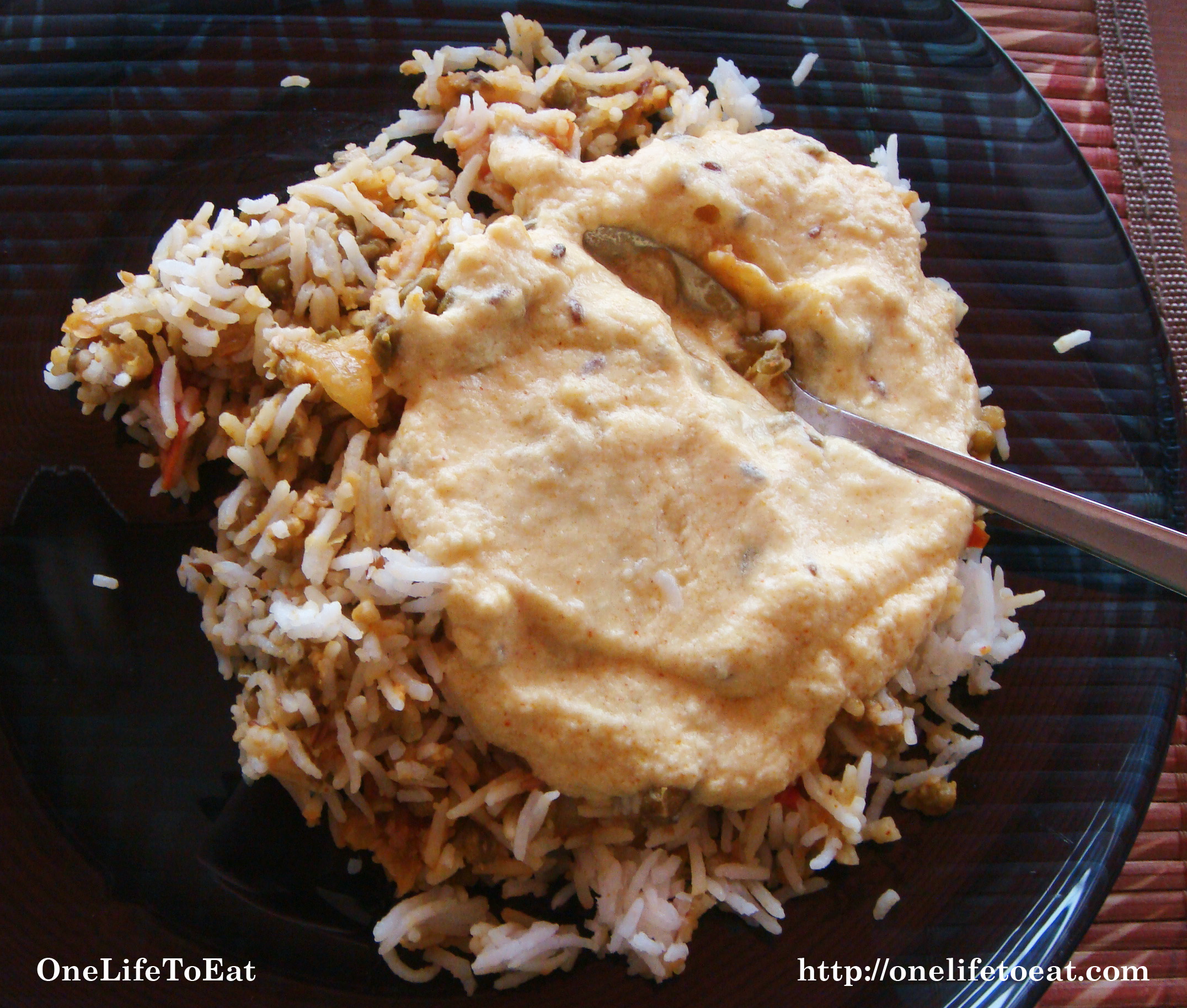
Kadhi ladled over Green gram Pilaf
Did you know that Kadhi actually helps alleviate symptoms of the common cold?
[tweetmeme source=”sabera” only_single=false]
The day has finally come to make the announcement. Today marks OneLifeToEat’s foray into Indian home cooking classes. After several hints by loyal readers who showed an interest in learning how to cook Indian food for real, I am launching OneLifeToEat’s Indian cooking classes, which will be held at my home kitchen in the Twin Cities, MN. I honestly think this will be a great learning experience for anyone who wishes to participate. Not only will I share with you simple methods of making yummy Indian dishes you enjoy at your favorite Indian restaurant, I will also teach you cooking techniques, how to use Indian spices, and how to best use them.
And who can say no to enjoying all the yummy food we make after each session?
Twin cities folks – what are you waiting for! Check your calendars and sign up for the class! Read more about the classes and how to sign up here.
Masoor Dal – Brown and Orange lentils
[tweetmeme source=”sabera” only_single=false]
I’ve written a lot about Indian lentils in my previous posts & recipes, simply because it is honestly such a big part of the Indian cuisine. To write this post, I went back and did some reading on Lentils and came across some really interesting facts. Did you know that the word Lens comes from the word Lentil, whose shape it resembles? Ain’t that cool?
I have personally noticed that the brown lentil is more popular in western cooking than any other lentil, as it is commonly used by chefs in recent years on TV shows to make salads, soups and even as a healthy side dish. As is with cooking on Television, some elements and methods become fashionable with chefs from time to time, and brown lentils were too, for a while.
The Masoor dal also known as Brown lentil, and when polished, orange lentil, is prepared for the most part, the same way as the Yellow daal is. The biggest difference though between the two is cooking times. When soaked in water for the same amount of time, Masoor dal takes roughly double the time to cook than Yellow toor dal. Ofcourse cooking time also depends on how you want to eat it. If you plan to eat it with Roti or Naan, you’d want to make sure you cook it to the point where each grain retains it’s shape and firmness. If brown lentils are to be enjoyed with rice, you have to cook it to a mushier stage so that it blends well together with the spices and vegetables, to result in a thick soup-y texture. In the latter case, the brown lentil is cooked with a handful of polished brown lentil, also known as orange lentil.

Brown Lentil - Masoor dal

Polished Brown Lentil - Orange lentil
What I appreciate about the way Masoor dal is prepared in the Indian cuisine, is the amount of herbs and medicinal seeds that go into it. Because the dal itself has a very earthy taste that may not be palatable to everyone, the herbs and seeds add an unique layer of aroma and flavor. I add aromatics such as curry leaves, fenugreek seeds, cumin seeds and black mustard seeds when making the dal.
In my home, everyone likes the mushier variety of Masoor dal. To make the drier, firmer version of the dal, simply cook with lesser water and for lesser time.

Masoor dal prepared
To make dal for 2-3 people, you will need:
- A pressure cooker or large pot
- 1 cup brown masoor dal
- A big handful of orange masoor dal
- 4-5 tbs vegetable oil
- A pinch of fenugreek seeds (optional – EXCELLENT for digestive and immune system)
- 2 curry leaves
- 1/2 medium onion, finely chopped
- 2 medium tomatoes, finely chopped
- 1 tbs ginger & garlic paste
- 1 tsp cumin seeds
- 1/2 tsp black mustard seeds
- 1tbs Dhania-Zeera powder (use 1/2 tbs each of Coriander & Cumin powder if you don’t get both as a mixture)
- 1/2 tbs chili powder
- 1/2 tsp turmeric powder
- Salt to taste
- Fresh chopped coriander leaves / cilantro leaves for garnishing
- Lemon juice

Masoor dal ladled over freshly cooked rice
Method:
- Wash and soak the 2 dals together for about 45 minutes. If you do not have a pressure cooker, soak the dals overnight in a large bowl with about 2 inches water above the level of dals
- In a pressure cooker or pot, heat the oil. When heated, add the curry leaves, cumin seeds, mustard seeds and fenugreek seeds. When they begin to crackle, add the onions. Be careful not to burn the cumin seeds.
- Cook onions on medium heat till they are a light brown and then add the ginger-garlic paste. Mix well and cook for a minute or so
- Add the chopped tomatoes and allow to cook till the mixture gets soft. While the tomatoes cook, drain the water from the soaked dals. Reserve the water for reuse in the cooking. It contains tons of water-soluble nutrients from the lentils.
- Now add all the dry spices and mix well
- Finally, add the drained dals and mix well
- Now add water as per your requirement
- If you want the mushier version, add about 2 cups of reserved or additional liquid to the dal and cook in the pressure cooker for about 4-5 whistles
- If you want the firmer version, add about 1 cup water and cook in pressure cooker for about 3 whistles
- If cooking in a pot, adjust water while cooking and cook till the dals have reached desired firmness / softness
- Once cooked, add salt to taste, and whisk together with an egg beater, if you are making the soup-y dal
- If making the drier version, burn off any excess water on high heat
- Garnish with lemon juice and about 3/4 cup of chopped cilantro




 One Life to Eat