Simple Carrot Pickle
[tweetmeme source=”sabera” only_single=false]
Pickles, known as Achaar in Hindi, and Indian food go together like Hamburgers & Fries. A traditional Indian meal is truly incomplete without a serving of assorted pickles, ranging from mango, to lemons to any kind of vegetable. Pickling in India is close to nothing like how it is done in the US. An assortment of spices, both whole and powdered, along with copious amounts of salt and oil, are allowed to cook down vegetables or fruits, mostly in the presence of strong sunlight. Pickles can also be sweet, where salt is replaced with sugar. Pickles in India are popularly a big summer activity in a traditional household – a dwindling way of living as most urban Indian families adopt more western lifestyles.

Most Indian families today buy ready-made pickles available in stores.
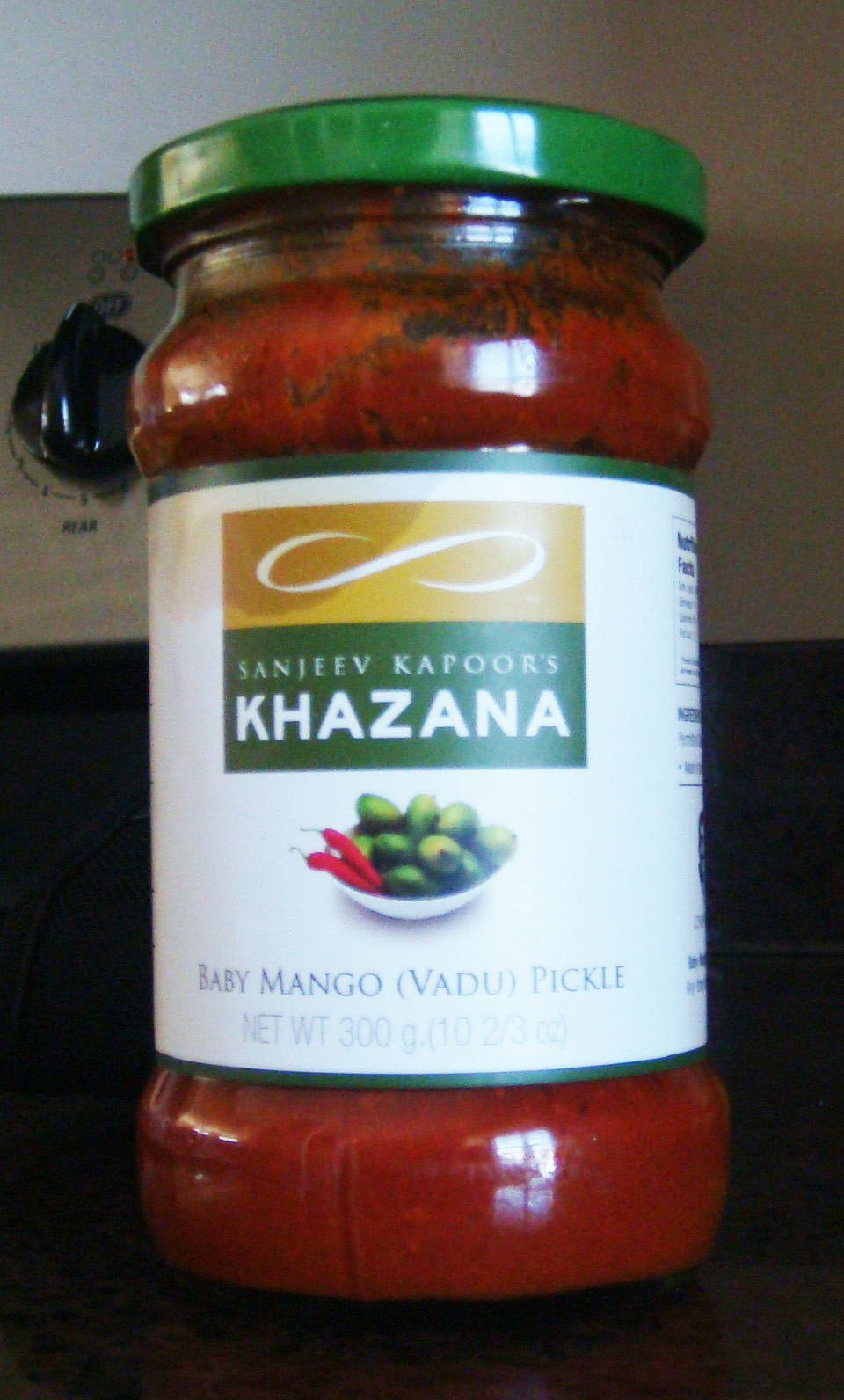
My favorite brand of mango pickle
Spending summer holidays at home in India, I remember seeing rows upon rows of pickles being allowed to cook in the sun, in our large balcony. My aunt’s specialty was lemon pickle. While she was also an expert at making raw mango pickle, her lemon pickles were why we had ample guests all day long, and mostly during meal times. She mixed raw lemons with salt and vinegar and let them cook in the strong sunlight of Mumbai summers.
After several days of cooking, mixing and remixing, the result was a delicious base pickle that went well with any dish made for lunch or dinner, but could also be mixed with other flavorings to make an assortment of other pickles. She added molasses to some batches of this base pickle, to make it a sweet / salty pickle, chili powder and other spices to a second batch to make it a tangy / spicy pickle, and so on.
While I really don’t have the inclination nor the patience to make a real pickle here in Minnesota, I do enjoy my pickles once in a while. What I enjoy most are mixed vegetable pickles that are low on spices and oil. My mother taught me a short-cut method of making carrot pickle. Replace carrots in this recipe, with any other raw, edible vegetable and you have your own Indian pickle to relish at home. Variations include cauliflower, peas, tender green beans, radishes, cucumbers, tomatoes or even a mix of all these veggies.
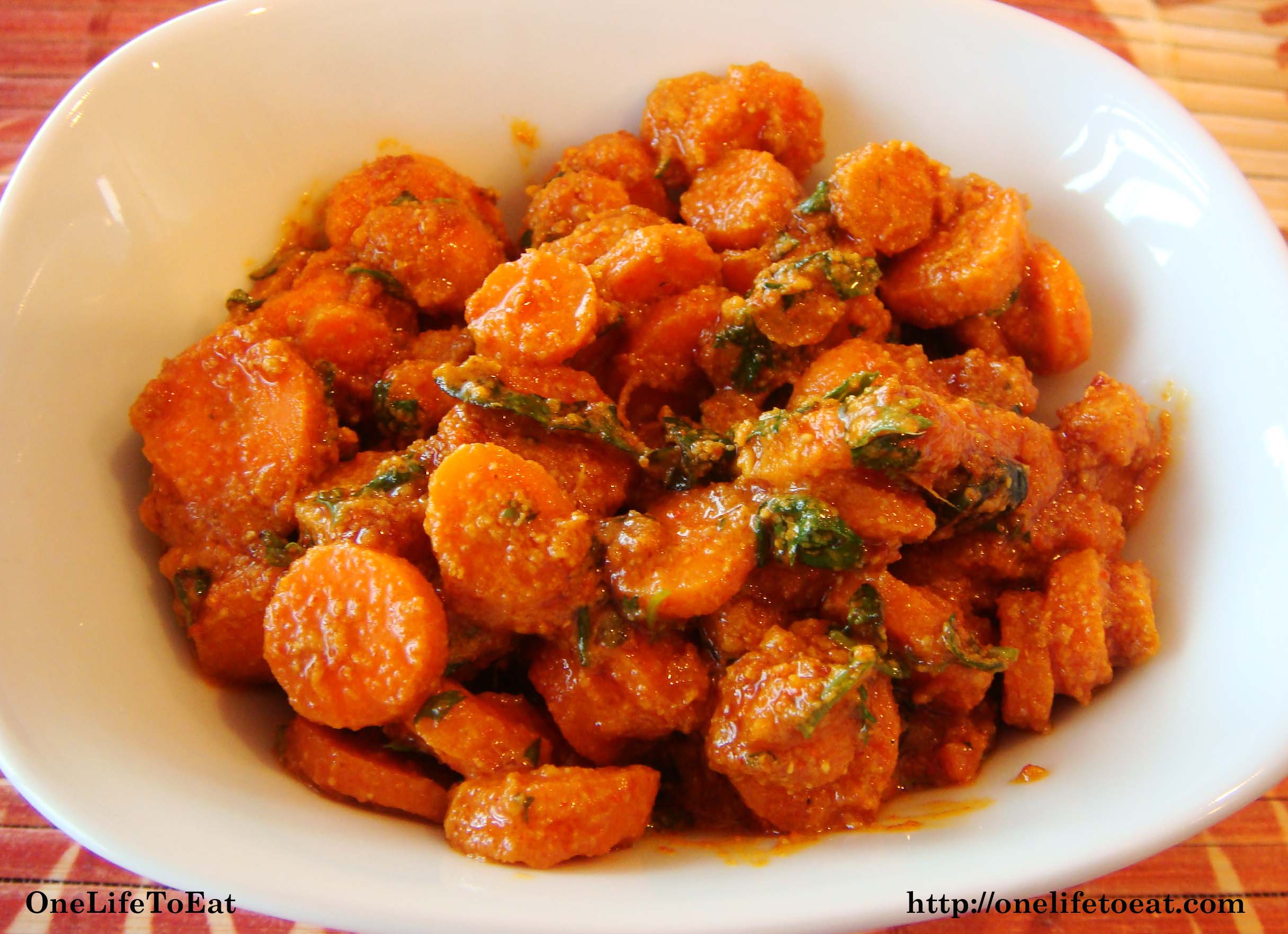
Simple Carrot pickle
Get a printable version of this recipe here.
You will need:
- About 1/2 lb baby carrots, sliced to about 1/8 inch thickness
- 1 tbsp vegetable oil
- 1 tbsp Cumin & Coriander powder – available as a blend in Indian grocery stores
- 1 tbsp salt or as per taste
- Juice of 1/4 lemon
- A handful of washed, finely chopped Cilantro
Method:
Mix all the ingredients in a glass bowl. You may add more Cumin & Coriander powder if you like the pickle to be spicier. Store in a glass jar and refrigerate for about an hour.
Enjoy with some Yellow daal & rice, or with your favorite Indian meal.
Add to:


A Taste of South India – Bisi Bele Bhaath
[tweetmeme source=”sabera” only_single=false]
This week on OneLifeToEat, I am shifting from my norm of writing about Indian recipes I’ve simplified. This week, good friend Vibha Karnik walks you through a South Indian wedding, its traditions and most importantly, its food. Vibha also shares her recipe for a sumptuous wedding favorite – Bisi Bele Bhaat: Lentils and Rice in a tamarind curry.
The West, I think, first saw an Indian Wedding in Mira Nair’s film, Monsoon Wedding. It was an introduction to our large families, our clothes, our colorful dance, our lavish wedding décor, our rich food and a whole lot of oomph. Soon, one Bollywood (India’s film industry) movie after another portrayed Indian weddings with the brides wearing ornate lehengas (a wedding dress worn by the bride), grooms donning grand sherwanis (a wedding outfit worn by the groom) and lots of dancing, which the Indian Diaspora lapped up.
I am an Indian. I stay in India; in the Southern state of Karnataka to be exact. I belong to the sub-community, collectively referred to as Kannadiga. As is always with films, our weddings are nothing like the ones portrayed in Bollywood! We have the large families, but there are no lehangas or sherwanis. We wear Kancheepuram sarees and most of the time the groom wears a white dhothi (traditional Indian men’s garment) with no shirt on top!

The author and her husband in tradition wedding attire
Weddings in India are a big affair. And every state and cultural region in India has its own customs, rituals and superstitions. A Hindu wedding in Karnataka is filled with rituals that involve the bride, groom and their parents toiling away long hours in front of the holy fire, performing rites and ceremonies. In fact, weddings in other Southern Indian states of Tamil Nadu and Andhra Pradesh are also very similar. It is in Kerala, another South-Indian state, where people get away with a 30-minute wedding; the shortest wedding in India for sure!
The wedding goes on for 3 days!
The very first ceremony involves building the Chapra, which literally means ‘roof’. A Chapra is a decorative shelter made in front of your home with leaves from a coconut tree, interwoven together, and holds a symbolical place in Indian weddings. In the old days, when the newspaper, television and radio did not exist, news was conveyed to people in person, by relatives or friends. The Chapra is a symbol of a wedding, developed in those times to let a news giver know not to convey bad news to a family that is celebrating a wedding. The Chapra is usually put up on an auspicious day before the wedding. With most people living in apartments now, there is hardly any space to erect a Chapra!

The author performing the Gowri Pooja at her wedding
After several intricate ceremonies following the Chapra ceremony, on the day of the wedding, the bride performs a Gowri Pooja (A prayer dedicated to Goddess Parvati) and seeks her blessings. The groom in the meantime ‘pretends’ to go on a pilgrimage to the holy city of Kashi, more commonly known as Varanasi. This is the funny part! The groom actually pretends to leave for Kashi to study as he is unable to find a suitable bride. Then the bride’s brother stops the groom and shows him his sister. On seeing her, the groom cancels his journey and agrees to marry her! I promise I did not make this up!
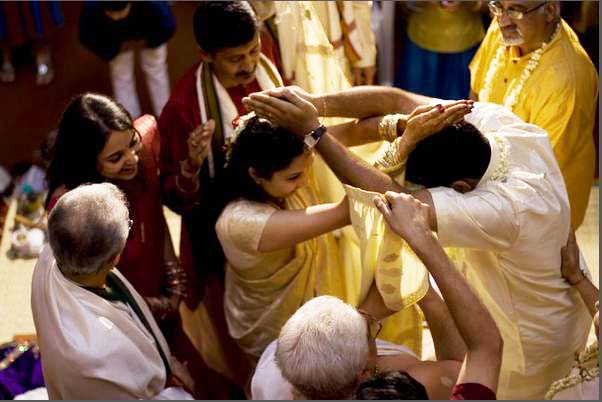
A ceremony in progress at the Author's wedding
After all the pre-wedding rituals, the actual wedding ceremony begins, and can last from two to six hours depending on how religious your family is. Towards the end of this long wedding, the couple takes the seven steps together called the Saptapadi; every step symbolizing a promise. This last step seals bride and groom in holy matrimony.
These are some of the important aspects of a Hindu Kannadiga wedding. Today however, South-Indian weddings have borrowed other, non-traditional ceremonies from Bollywood, that make weddings more fun and add a touch of glamor.
But all has not changed.
Something about a Kannadiga wedding that still remains untouched by influences is the food. And more importantly how it is served. The meal is always vegetarian and served on a banana leaf. What is important to note is that there are multiple courses, and a particular sequence in which the food is served and a specific place for everything dish on the leaf.

South-Indian wedding food served on a banana leaf
The first dish to be served is the payasa, a milk-based sweet dish. It is always served on the lower right hand corner. One must eat this first as it is symbolic of the happy event. Then follows multiple courses of sumptuous, delicious food. The payasa is followed by salt, pickle, a salad dish called kosambari, and playa which could be vegetables like cabbage, beans or beet root cooked with mustard seeds and coconut which are all served on the leaf. A flavored rice dish such as lemon rice, tamarind rice or mint rice comes next. This is served on the left hand side of the leaf.
The meal ends with the main course (no, not dessert), which consists of rice eaten with a lentil preparation. Bisi Bele Bhaath, which literally translates to Hot Pulse Rice, is a common lentil dish served as the main course. It is a great meal by itself and healthy too!
Here’s my recipe for Bisi Bele Bhaat – Lentils and Rice in a tamarind curry

Bisi Bele Bhaat
Get a printable version of this recipe here.
Ingredients:
- 1 cup par-boiled rice
- 1/2 cup toovar daal or Pigeon Pea gram, cooked well
- 5-6 Tamarind pods soaked in warm water for ½ hour or so. Drain and keep the water aside
- 2 cups of peas, beans and carrots, cut into ½ inch pieces, cooked till almost done
- Salt to taste
Method:
Heat 1 tsp oil in a pan. When the oil is heated add 2 table spoon coriander seeds, 8-10 ( or according to taste) dried red chilies 2 tsp urad daal (white lentils), 1/4 inch cinnamon stick, 6-8 pepper corns, 1/2 tsp white poppy seeds and 1 tsp cumin seeds. Fry this together till your kitchen in fragrant.
Remove from heat and add 2-3table spoons of grated coconut to this mixture. Do not add desiccated coconut. Grind this coarsely in a blender and spice grinder.
In a big pan, heat 3 tbsp of oil or ghee in big pan. Add mustard seeds and curry leaves.
Add the cooked pigeon pea gram, the ground spice mix, tamarind water, salt to taste and the par-boiled rice. Add enough water to cover the mixture. Cook on medium heat stirring frequently so that it does not get burnt. You may add more water if necessary. When the rice is well done, take the pan off the heat.
In a separate pan, heat 1 tsp of ghee. Heat and add cashew nuts slit lengthwise. Garnish the dish with these fried cashew nuts.
Tip: Enjoy the dish about 4 hours after you finish preparing it. The taste is much better.
Vibha is a marketing communications professional working for HID Global (www.hidglobal.com) and she stays in Bengaluru, India. She is a dreamer, a planner, an optimist and a complete idealist. Vibha also blogs at: http://roller-coastering.blogspot.com

Vibha Karnik
Chholey Masala – Indian Chickpea curry
[tweetmeme source=”sabera” only_single=false]
Chickpeas, also known as Chholey in North India and Garbanzo beans here in the US, is one of my favorite legumes. Indians prepare it in a spicy, tangy curry, using spices such as dried mango, cinnamon and bay leaves. I recall first savoring it at a family dinner, with abnormally large poori’s or fried Indian flatbread.
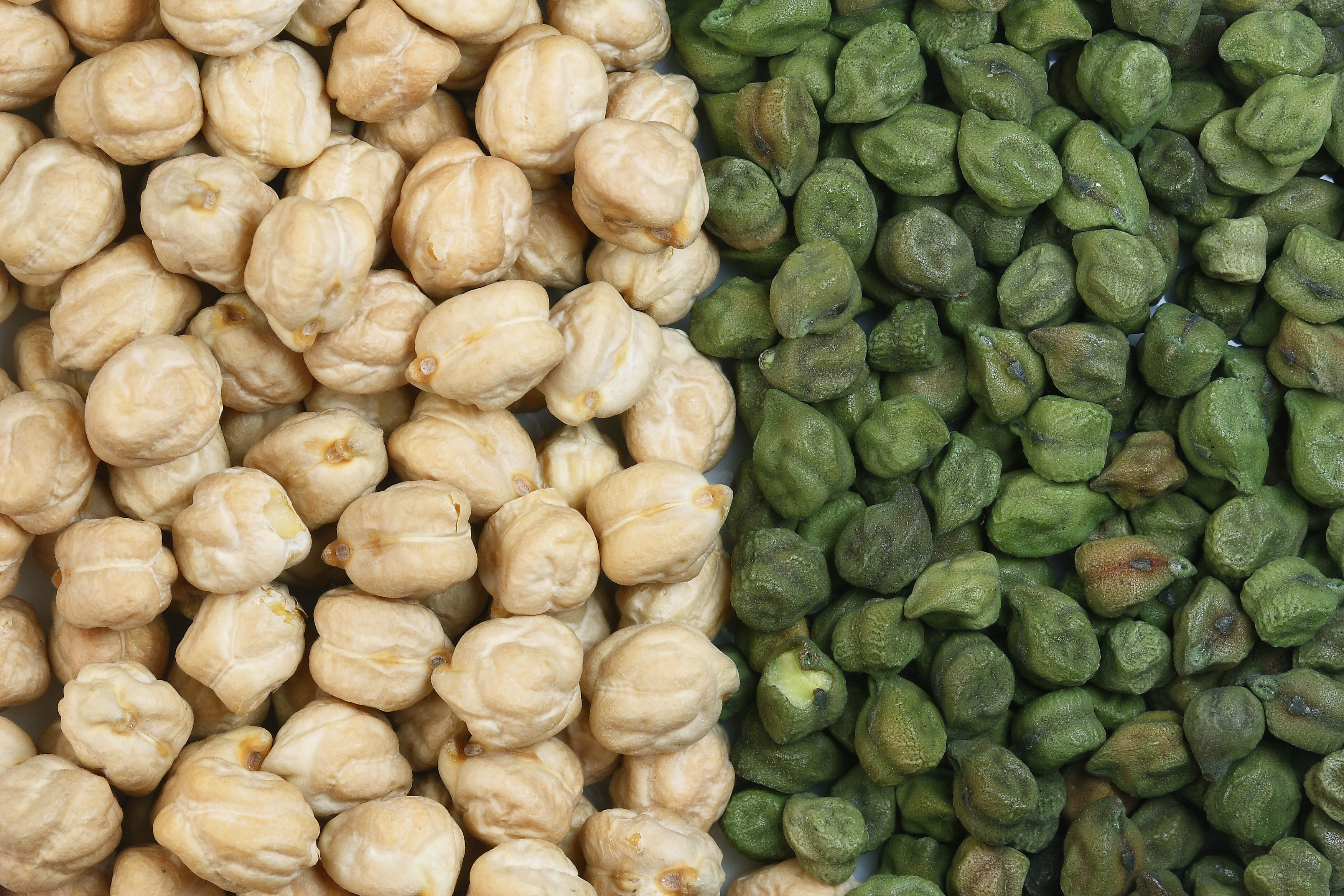
White & Green chickpeas. Photo credit: Wikipedia
As you may know, chickpeas are available in 2 varieties – white & green. In India, you’ll commonly find both varieties being used in traditional home cooking. The white variety is made into Chholey puri – chickpea curry with fried Indian flatbread – a famous inclusion in most Indian restaurants and interestingly, also a favorite breakfast dish amongst North-Indians.
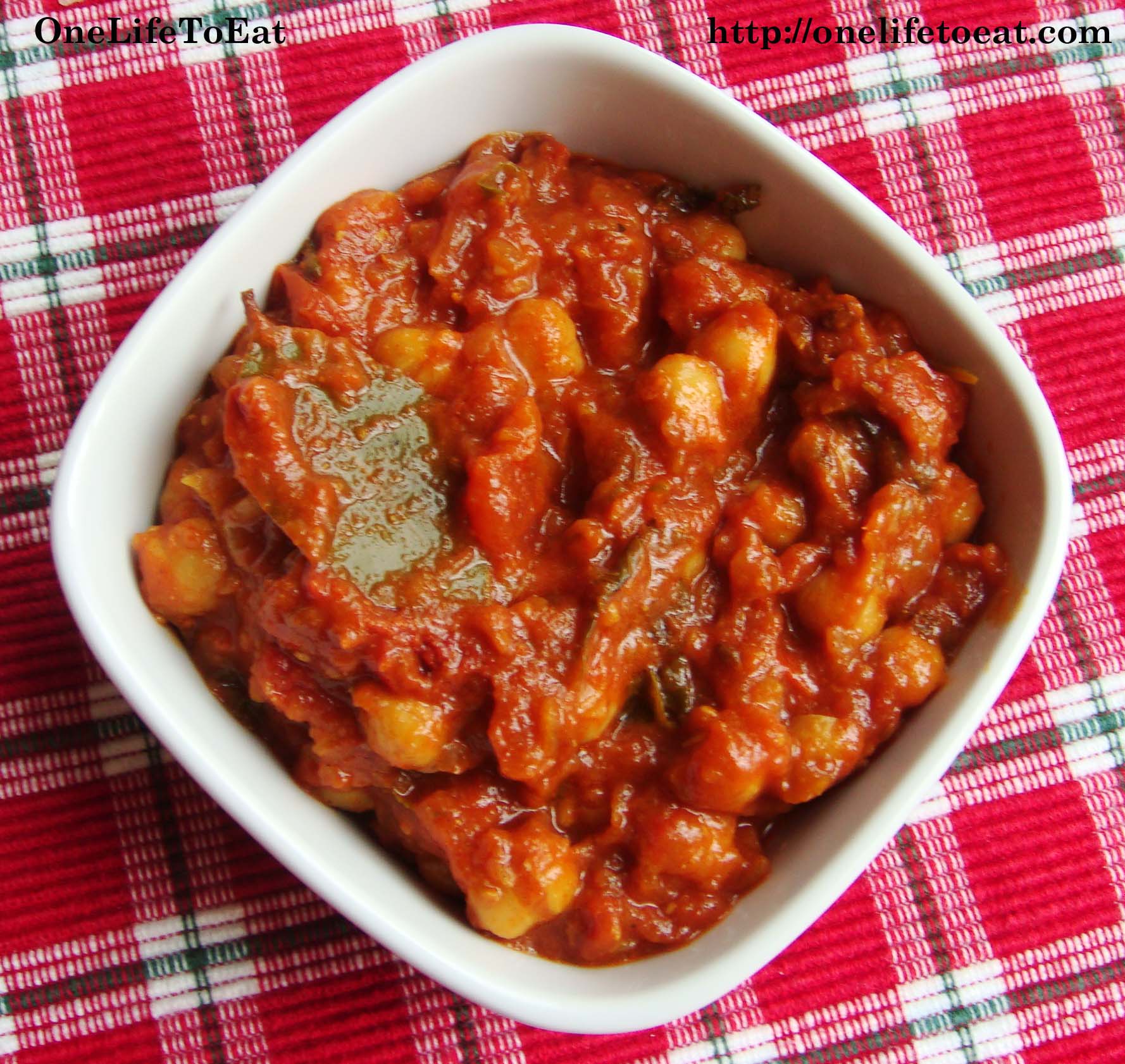
Chickpea curry / Chholey Masla
The green variety on the other hand, is eaten as a snack in Mumbai, spiked with chopped onions, tomatoes, green chilies (yes, it’s very very hot) and tons of tangy spices that go excellently with the sweltering heat in the city I love. On a train ride from Mumbai to Kolkata in India, I was once served this very concoction, but with a distinct flavor to it. I later learned that in West India, they prepare green chickpeas in mustard oil. (Travel Tip: for the ultimate green chickpea snack, go to Chowpatty beach in Mumbai, India, and buy a portion from any street vendor)
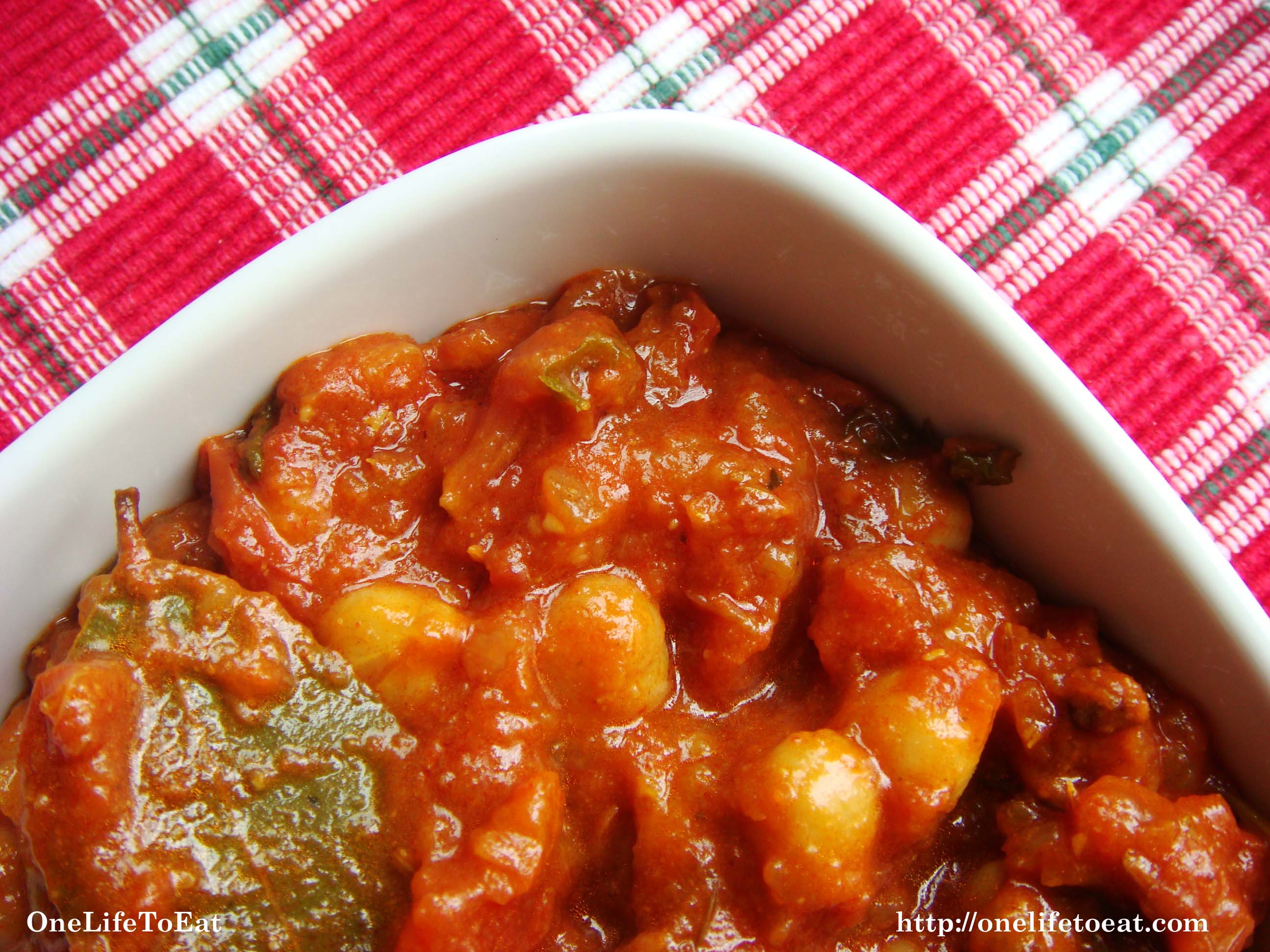
There’s something about chickpeas that I’ve always found very comforting. They really hold their shape during the cooking process, making them firm on the outside, and mushy when you bite into them. Perfect when had on a cold winter evening, I find it equally enjoyable in the pleasant Minnesotan summer.
Get a printable version of the recipe here.
You will need:
- 1 cup white chickpeas / garbanzo beans. Wash, cover with about 4 cups of water in a large bowl, and soak overnight
Note: you may also use cooked, canned Garbanzo beans. Follow the recipe as below.
- A pressure cooker (if using raw chickpeas) or large pot (if using cooked canned garbanzo beans)
- 2 large tomatoes, finely chopped OR equivalent amount of canned tomato puree
- 1 large onion, finely chopped
- 4 tbsp oil
- 1/2 tsp cumin seeds
- 3 inch stick of cinnamon
- 3-4 dried bay leaves
- 1 clove garlic, finely chopped
- 1 tbsp ginger & garlic paste
- 1 tsp chili powder
- 1 tbsp Dhania-Zeera powder or Cumin & Coriander powder spice blend
- 1 tsp Amchur powder (dried powdered mango – available in any Indian grocery store)
- 1 tsp salt or as required
- Coriander leaves and lemon juice for garnishing
Method:
- In the pressure cooker or pot, heat the oil. Once heated, add the cumin seeds, cinnamon stick and bay leaves. Once they release their fragrance and the cumin seeds begin to pop, add the onions. Cook till they are golden-brown
- Then add the chopped garlic and the ginger & garlic paste. Mix well and add the chopped tomatoes. You can also use canned tomato puree if you have that at home. Mix well and allow to cook for 2 more minutes
- Add all the dry spices, mix well and wait for the oil to separate from the sides
- Finally add the raw soaked chickpeas or the cooked, drained garbanzo beans.
- If you are using the Garbanzo beans, cover the pot and allow the mixture to simmer for 15-20 minutes on medium heat
- If you are using raw chickpeas, cover the pressure cooker and allow to cook for 4-5 whistles
- Garnish with chopped coriander leaves & lemon juice. Enjoy with your favorite Indian bread.




 One Life to Eat